

Pool & Spa Heaters

Simply stated, pool heaters provide more fun, more relaxation, more comfort and a longer swimming season to enjoy.

There are 3 types of pool/spa heaters commonly used in our industry. Gas heaters (Natural or Propane), electrical resistance, and electrical Heat Pumps.

Gas heaters have been around the pool industry for over 60 years and they come in many shapes and sizes. From 65,000 BTU’s to over a million BTU’s commonly used in commercial properties. The advantage gas heaters have over the other types of heaters is that they heat faster. A flame is produced via a source (natural or propane) and a gas valve and igniter.

This flame is then directed over a heat exchanger that has water passing thru it. This heat exchanger usually made from an alloy called cupronickel then effectively transfers the heat to the pool/spa water.

The new energy efficient gas heaters have closed combustion chambers that reduce the amount of air pollution exhaust.

Today’s gas heaters are more efficient then the heaters of only 5 years ago.

Electrical resistance heaters are commonly used in small bodies of water such as spas or small pools. These types of heaters have one or more heating elements that heat the water. One of the advantages of this type of heater is it is smaller than the others and fits into places that have size restrictions.

Electrical resistance heaters are designed to maintain the water temperature at a desired range, similar to a water heater in your home. They are not designed to raise water temperature quickly and as such are not very energy efficient.

Heat Pumps

The technology for heat pumps was invented back in the 1940’s . By accident first heat pump was built by the American inventor Robert C. Webber. It all basically happened by accident when, in the late 1940′s, Webber was experimenting with deep freezing equipment and he unintentionally touched the outlet pipes of the cooling system, burning his hand.

This led him to the idea behind the basic mechanics of a heat pump. He connected the outlet piping from a freezer to a hot water heater and, since the freezer was producing constant excess heat, he hooked up the heated water to a piping loop and, using a small fan, he started to force the warm air into the building. He continued to experiment by successfully harvesting heat from the ground using below-grade heat collectors. In fact, he was so satisfied with his discoveries that only a year later, he decided to sell his old coal furnace.

This great idea was then modified to heat swimming pools. This is how it works:

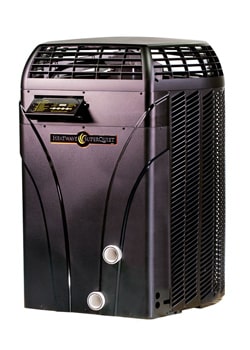
Heat pumps use electricity to capture heat and move it from one place to another. They don’t generate heat.

As the pool pump circulates the swimming pool’s water, the water drawn from the pool passes through a filter and the heat pump pool water heater. The heat pump heater has a fan that draws in the outside air and directs it over the evaporator coil. Liquid refrigerant within the evaporator coil absorbs the heat from the outside air and becomes a gas. The warm gas in the coil then passes through the compressor. The compressor increases the heat, creating a very hot gas that then passes through the condenser. The condenser transfers the heat from the hot gas to the cooler pool water circulating through the heater. The heated water then returns to the pool. The hot gas, as it flows through the condenser coil, returns to liquid form and back to the evaporator, where the whole process begins again.

This process makes for a very efficient method of heating your pool. Since it does take longer than a traditional gas heater, it is really designed to maintain the desired water temperature; hence it is very energy efficient. The C.O.P. (coefficient of performance) is a rating given by AHRI. An example of C.O.P. could be 6.4 which would translate to , “ For every dollar of electricity you put in , you get about 6.4 dollars worth of heat.” With this type of savings you can use your pool year round.

Heat pumps can also be used to chill your pool. The reverse cycle, which is an option, can keep your pool during the hot summer months. Simply turn a switch and your heater can become a chiller. These types of options are commonly sold in warmer regions where the summer makes the pool too hot.


Featured Pool Heater Brand:


Rheem Classic Heat Pump

Three Sizes: 95,000, 117,000, 133,000 at 80/80/80
AHRI Certified and Listed
Scroll Compressor
Titanium spiral Tub Heat exchanger
2″ PVC Union connections
Analog or digital control
COP up to 606 at 80/80/80, meets Florida 4.0 minimum COP

View details

Rheem Digital and Millivolt

Four Sizes: 199,500, 266,000, 332,500 & 399,000 BTU/HR
Copper Fin Tube heat exchanger, rust-free waterways
2″ water connections
Digital control with self-diagnostics
Meets or Exceeds Federal Energy Standards
Natural or Propane Gas

View details


Rheem Digital Low NOx

Four Sizes: 199,000 266,000, 332,500, 399,000 BTU/HR
Copper Fin Tube heat exchanger, rust-free waterways
Fan assisted stainless steel Low NOx burners
2″ water connections
Digital Control with self-diagnostics
Meets or Exceeds Federal Energy Standards
Natural or Propane Gas

View details

Rheem Electric SpaPak

Two Sizes: 5.5 & 11 KW
Brass & Copper water vessel
1-1/2″ Male NPT water connections
Incoloy Heating Element
Meets or Exceed Federal Energy Standards
Indoor or Outdoor

View details


Rheem Specialty Series Heat Pump

Two Sizes: 110,000 & 133,000 BUT/HR at 80/80/80
Power Defrost 117,000 BTU/HR
AHRI Certified and Listed
Scroll Compressor
Titanium spiral tube heat exchanger
2″ PVC Union connections
Digital Control
COP up to 6.2 at 80/80/80, meets Florida 4.0 Minimum COP

View details

Rheem Versa™

One Size: 130,000 BTU/HR
Copper Fin Tube heat exchanger, rust-free waterways
2″ Water connections
Meets or Exceed Federal Energy Standard
Natural or Propane Gas

View details


Rheem Versa™ Above Ground

One Size: 50,00 BTU/HR
Copper Fin Tube heat exchanger, rust-free waterways
1-12″ Water Connections
Condensation-free operation
Meets or Exceeds Federal Energy Standards
Natural or Propane Gas

View details


Additional Pool Heater Brands We Carry:


TESTIMONIAL:

“My mother got a pool from a different company but she didn’t have enough money to pay for a pool heater, then getting in the pool was a horror movie! It was so cold that any of us wanted to get in. So, I looked for some money and I purchased a pool heater from this company. Now, we can enjoy our pool and its excellent warm water!”